Borrowing dollars without selling your francs
How yield-bearing assets and FX liquidity can open new lending markets, using svZCHF as a model for borrowing dollars against Swiss franc savings.


DeFi lending is still overwhelmingly dollar-based. Users lend dollar stablecoins, borrow other dollar stablecoins, or post volatile crypto to borrow dollars.
But someone saving in Swiss francs may also want to borrow money, whether to cover expenses or use it elsewhere, without selling their CHF position. That requires a way to use those savings as collateral in the dollar lending markets where most of the liquidity sits.
Liquidity between currencies is growing but remains limited, and even where borrowing is possible, the interest can make keeping the CHF position expensive.
The new svZCHF market on Llamalend v2 shows how this can become more practical. The existing zCHF/crvUSD FXSwap pool provides liquidity for pricing and liquidations, while the Swiss franc collateral continues earning a savings yield that helps offset borrowing costs.
From savings to lending
The obvious starting point would be a market where holders borrow crvUSD against zCHF itself. Curve already has an FX pool connecting the two assets. But making borrowing possible does not automatically make it attractive. Plain zCHF earns no yield, so the holder would be paying significant interest on the loan to attract lenders to provide the liquidity in the first place.
Frankencoin introduced a savings token, svZCHF, which changes that calculation. It represents zCHF deposited into the protocol’s savings system, allowing holders to earn the savings yield simply by holding the token. That means if it's used as a collateral in Llamalend, you would keep earning that yield. That income then helps offset the interest paid on a potential loan.
Using a different collateral token could have meant needing a new pool and attracting another set of liquidity providers. But svZCHF can be unwrapped into zCHF, so the lending market can use the existing zCHF/crvUSD liquidity.
That gives the initial FX pool a role beyond exchanging currencies. Its liquidity now supports a new credit market where holders can borrow dollars against their Swiss franc savings. The pool provides a price for the underlying zCHF and a route to convert it into crvUSD if the collateral needs to be liquidated.
What remains is attracting lenders willing to supply the dollars at a rate that makes borrowing worthwhile.
A market needs both sides
Yield-bearing collateral and existing FX liquidity make this lending market possible, but they do not provide the dollars to lend. Someone still needs to supply crvUSD, and the savings income earned by svZCHF holders does not go to those lenders.
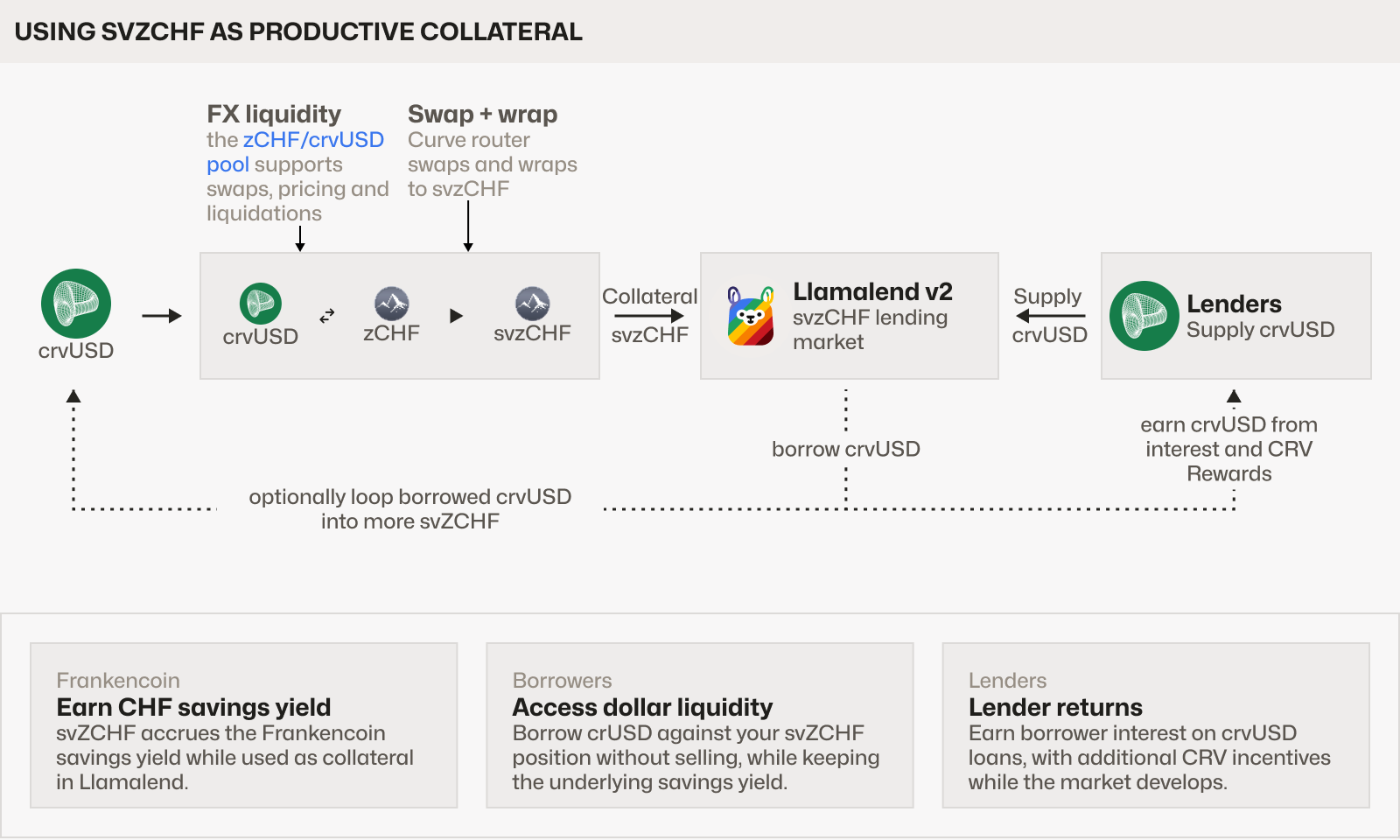
It can, however, raise demand for loans, and the subsequent interest they are ready to pay lenders. Borrowers can use crvUSD to buy more zCHF, deposit it into savings and increase their svZCHF collateral. The opportunity to earn on a larger CHF position gives them another reason to borrow, and the interest they pay generates income for lenders. That demand depends on savings income relative to borrowing costs, swap costs, and CHF/USD movements.
Lender incentives also help attract lender supply while that demand develops. As of 30th of September, lenders had supplied roughly 458k crvUSD, with 240k crvUSD borrowed across eight active loans. Utilization was about 43%, and most of the indicated lender return came from CRV rewards rather than borrower interest. Borrow rate oscillate around 1% on a monthly average, making it profitable for users doing leverage looping, with a estimated maximum APR of 21.09% in zCHF at the time of writing.
That support is valuable while the market develops, but it comes at a cost within Curve’s broader emissions programme. Attracting deposits is only part of what those incentives need to achieve. The aim is to grow borrowing that remains worthwhile for users and generates enough interest to become the main source of lender income over time.
The svZCHF market shows how existing FX liquidity and a savings token can make dollar credit available against Swiss franc savings. The infrastructure is in place, and the remaining challenge is making the economics work for both sides as the market grows.