Curve Monthly Recap July 2026
Llamalend V2 reached Ethereum mainnet, average crvUSD borrow rates fell by nearly two-thirds, and borrower-minted crvUSD grew 29%.

The work done throughout June started to show results in July. Llamalend V2 landed on Ethereum mainnet with three new isolated markets deployed, while borrowing against crvUSD became markedly cheaper, and demand for the crvUSD grew by close to a third.
Key Highlights of July
- Llamalend V2 went live on Ethereum mainnet: sDOLA and sfrxUSD were activated through governance on 21 July, and a third market, syrupUSDC, was deployed on 24 July with its borrow cap approved by a vote that executed on 2 August
- Average crvUSD borrow rates fell from 5.6% to 2.0% over the month, and minting increased in every weekly reading
- crvUSD minted grew 29% to $36.7M, and collateral backing those mints grew 43% to $70.5M
- A public call for proposals drew nine bids to replace LlamaRisk as the DAO's risk provider
- The DAO approved a treasury stable diversification contract and began routing Arbitrum and Base fees to the treasury
- A new monetary policy class, HyperbolicMP, was written and put to a vote for the V2 markets
- Flying Tulip, Andre Cronje's latest venture, brought ftUSD to Curve and voted for its own gauge
- Curve deployed on the Robinhood chain, joined the Money League, and passed 1,000 Stableswap-NG pools on Ethereum
Llamalend V2 Arrives on Ethereum
Llamalend v2 is coming to Ethereum.
— Curve Finance (@CurveFinance) July 15, 2026
It brings lending closer to Curve liquidity, with isolated markets, flexible asset pairings and support for Curve LP tokens as collateral.
The first markets will roll out gradually through Curve governance.https://t.co/LnTLbQLMLw pic.twitter.com/adNKy26d9D
Llamalend V2 expanded from Optimism to Ethereum mainnet in July. Unlike V1, crvUSD is no longer mandatory in every market. Supported assets can sit on either side, while each market has its own oracle, interest-rate model, parameters and borrow cap. V2 can also support productive collateral such as Curve LP tokens and yield-bearing vault tokens.
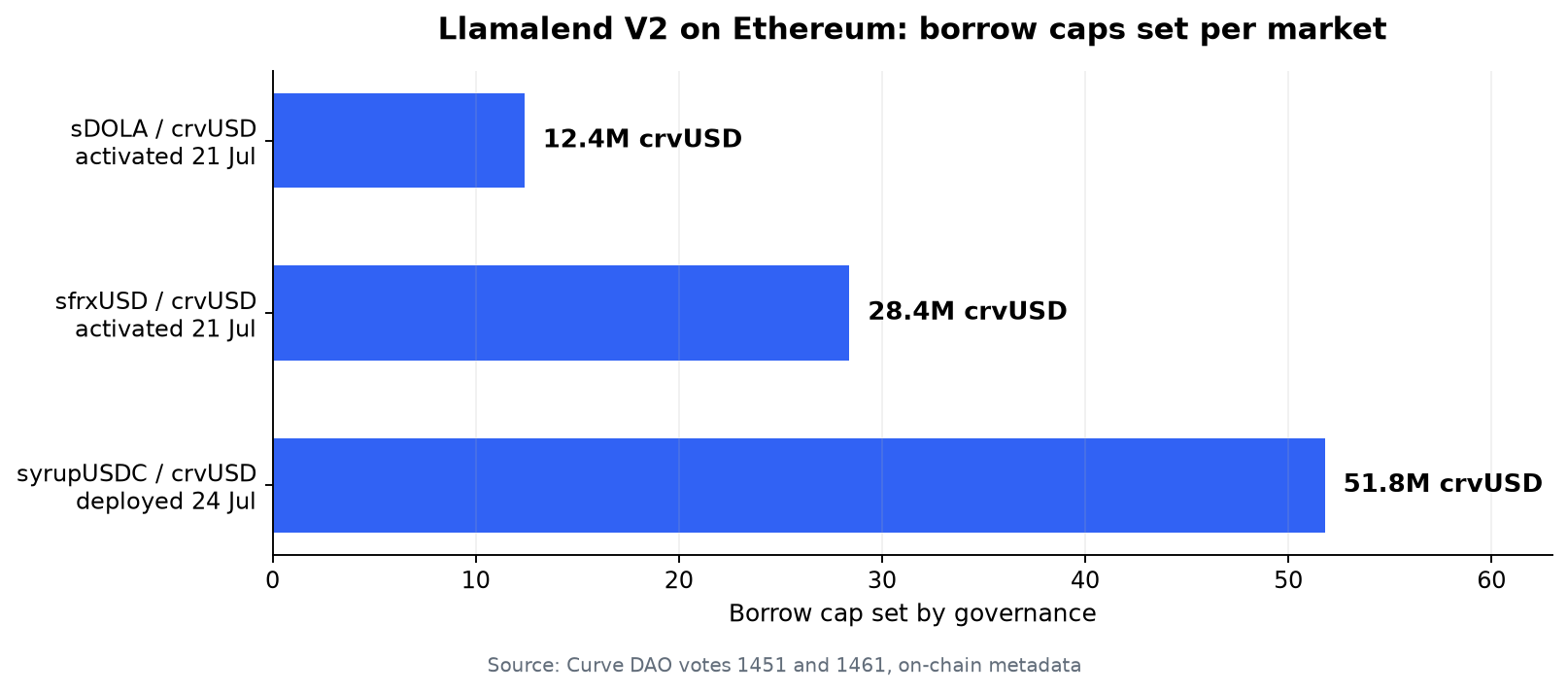
Each new market is deployed with borrowing disabled and requires governance to approve a non-zero cap. The first Ethereum markets focused on yield-bearing stablecoin collateral. Markets for borrowing crvUSD against sDOLA and sfrxUSD were activated on 21 July (Vote 1451), with caps of $12.4M and $28.4M crvUSD. A syrupUSDC market was deployed on 24 July (Vote 1461), with a $51.8M cap. Each market carries a 10% admin fee to the DAO, and a companion vote accepted ownership of the new Gauge Factory so CRV emissions could follow (Vote 1452).
The first Llamalend V2 markets are now live on Ethereum:
— Curve Finance (@CurveFinance) July 21, 2026
sDOLA by @InverseFinance
sfrxUSD by @fraxfinance
Lend, borrow, or boost your yields → https://t.co/Bad9UrQpWW pic.twitter.com/zEFkzmbo0t
Markets open with borrow caps at zero and are raised in step with risk review, so the launch sequence is deliberately gradual. Even at this early stage, July brought activity on both sides of the market. Substantia Fund moved its BTC borrowing from Aave to Llamalend, citing liquidation protection, and Stake DAO committed $200K from its treasury to bootstrap liquidity in the new markets through OnlyBoost.
By month end, borrowing across Curve's mint and lend markets stood at $80.2M against $72.6M at the start of July, and the collateral behind those loans grew from $102.6M to $123.5M.
 Curve News
crvUSD: Borrowing Gets Cheap Again
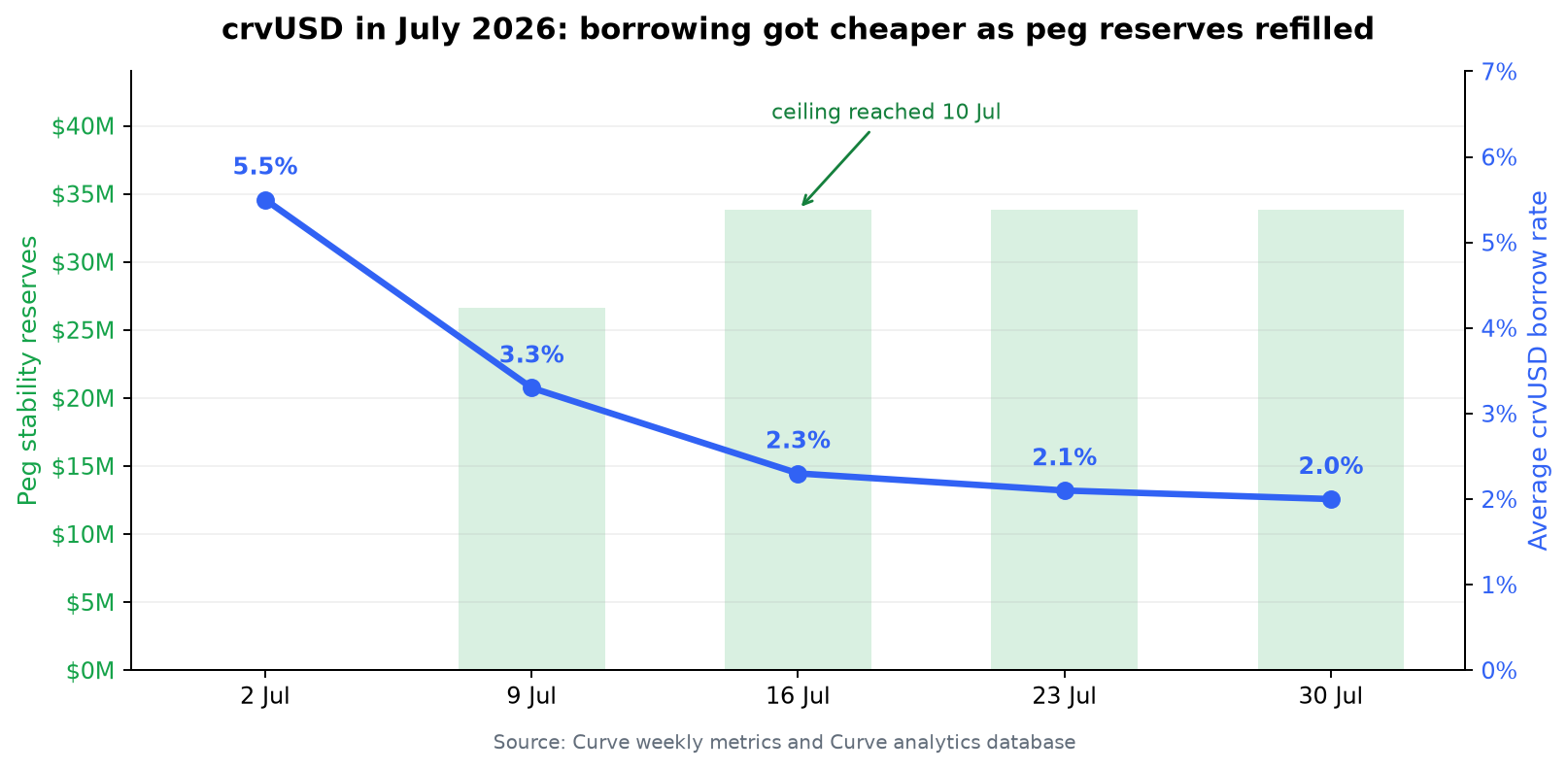
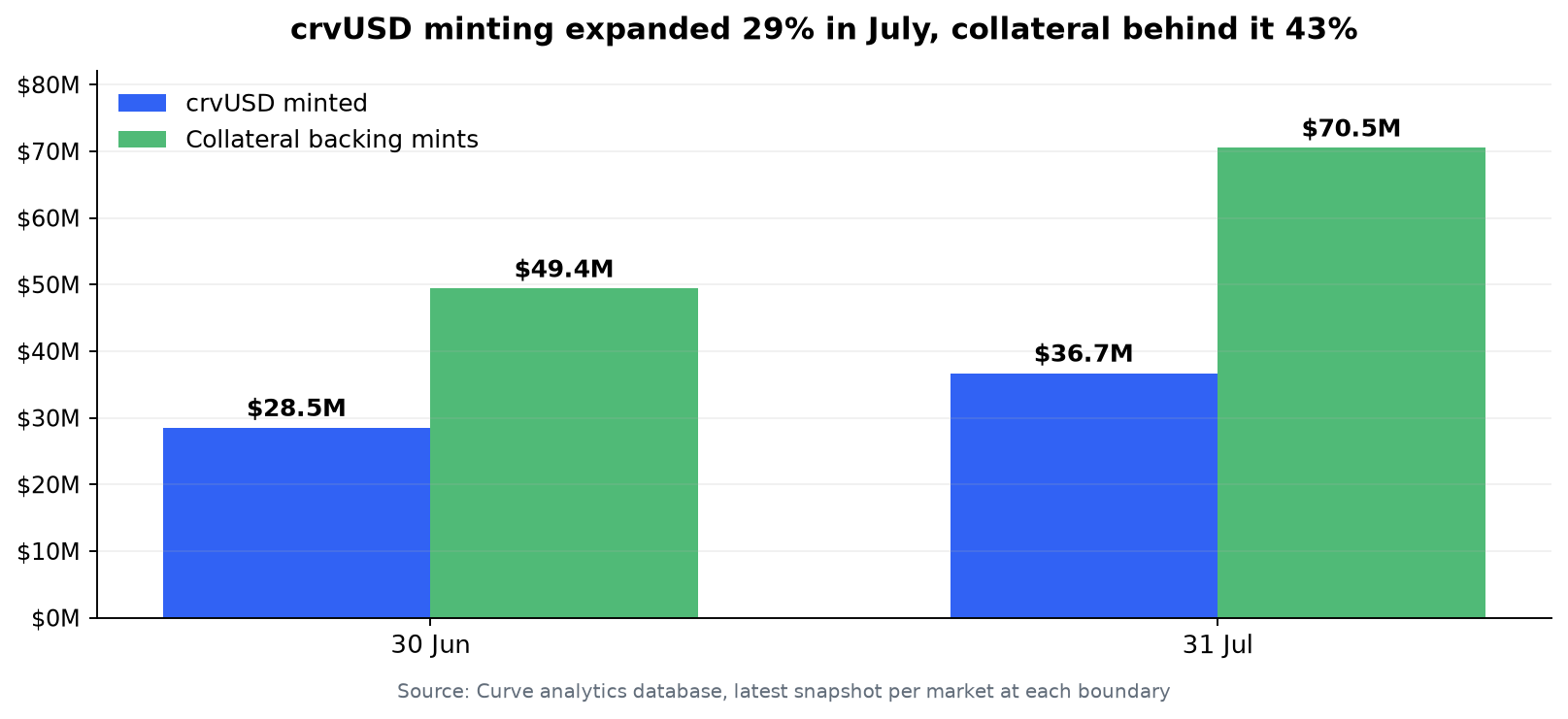
Borrowing crvUSD became materially cheaper in July. The debt-weighted average rate across mint markets fell from 5.6% at the end of June to 2.0% at the end of July. Over the same period, borrower-minted crvUSD grew 29% from $28.5M to $36.7M, while collateral supporting those loans rose 43% from $49.4M to $70.5M. Minting increased at every weekly snapshot during the month.
The peg held throughout, trading between $0.9992 and $0.9998 on daily closes. Peg stability reserves stood at zero at the end of June, two months of falling leverage having left nothing for them to do. July put them back to work: the crvUSD/USDT keeper made 24 consecutive provisions between 3 and 10 July, reaching $33.75M and stopping there. What stopped it was not the size of its allocation — $101.25M of the $135M assigned to it is still unspent — but the regulator's rule on how much of that allocation a single keeper may deploy while the others sit idle: a quarter, which comes to exactly $33.75M. Reserves coming back from zero is routine — over the past two years the keepers have returned to work thirteen times and have sat at zero a quarter of all days. What is worth noting is where it stopped: no withdrawal followed, so demand for crvUSD spent the rest of the month pressed against a limit the DAO has not yet revisited.
Raising that limit is already on the agenda, and so is the broader question behind it. Presenting a modest $5M cap raise for the YieldBasis WETH pool on 2 July, Michael Egorov said a research piece and a mechanism for lifting pool caps without a fixed bound, in a way that stays safe for crvUSD and the protocol, would follow shortly.
Proposal to raise WETH @yieldbasis pool cap by a tiny bit ($5M).
— Michael Egorov (@newmichwill) July 2, 2026
Very soon though, we will present a research and solution how to do unbounded raises of the pool caps in ways safe for crvUSD and the protocol.https://t.co/15yp4zSCIK
As crvUSD supply expanded, the share held in scrvUSD fell from roughly 65% to 52%. The realized savings rate also declined from 4.1% to about 1.2%, as the same yield was spread across a larger, cheaper borrowing base.
Alongside the markets themselves, July produced a new monetary policy class. HyperbolicMP was written mid-month and put to governance for the mainnet sDOLA and sfrxUSD markets and for the Optimism V2 markets (Votes 1462 and 1463), replacing the policy the first markets launched with.
Mint crvUSD · Borrow on Llamalend V2
The Search for a Risk Provider
With LlamaRisk's engagement concluded at the end of June, the DAO opened a public call for proposals on 7 July covering two scopes: crvUSD peg and mint market risk, and isolated Llamalend markets. The brief asked bidders to name responsibilities, KPIs and budget, and required that tooling, models and documentation remain with the DAO after any mandate ends.
Nine proposals arrived within two weeks: Curvature, Pharos Watch, Xerberus, BA Labs, Tulipa Capital, Manifold, CrossWorlds, yRisk and Blockworks Advisory. The submissions differ on almost every axis. Annualised asks span an order of magnitude, from Xerberus at $100K paid entirely in CRV locked for four years to Tulipa at $1M for full operational coverage. Several bidders took only one scope, which leaves open the option of splitting the mandate between two providers. The mandate is yet to be awarded to a provider, with discussions ongoing and DAO votes set for early August.
Thanks everyone who submitted proposals for working on risks for Curve. These proposals exceeded our expectations and are of very high quality, made by strong and experienced teams.
— Curve Finance (@CurveFinance) July 23, 2026
Check the gov forum for the next stepshttps://t.co/P2FzFEJcHw
Curve.finance GovernanceTreasury and Governance
July changed how part of Curve’s L2 revenue reaches the DAO treasury. Vote 1445 enabled crvUSD held by the Arbitrum and Base fee collectors to be bridged to the treasury on Ethereum. This included crvUSD already accumulated on those chains and future amounts entering the same fee collectors. The vote did not yet update the factory fee receivers, so it did not redirect every new admin fee generated on Arbitrum and Base.
Later in the month, Vote 1456 transferred ownership of the Treasury Stable Diversification contract to the DAO and authorised it to pull treasury crvUSD. The contract can perform controlled conversions into selected yield-bearing stable assets, initially sDOLA and sfrxUSD, before returning the resulting tokens to the treasury. The vote created the mechanism for diversification but did not itself execute a conversion.
July carried 27 ownership votes in total, numbers 1446 through 1472. Beyond the V2 activations, the month's recurring theme was housekeeping: roughly a dozen gauge additions across USG, trUSD and eva pools, ramps of the A parameter on USDG and on the FIDD pools, and a coordinated removal of the Odos router from Leverage Zap contracts on five chains after Odos announced it was winding down.
Governance also revisited the parameters of TricryptoUSDT, which serves as a price source for crvUSD mint markets. The proposed changes adjusted A, gamma, fees and related controls to improve liquidity density and oracle health. The parameters were stress tested using variations of historical BTC and ETH price paths (forum thread). The first attempt did not pass, with 369M veCRV against and 118M in favour; an identical proposal cleared four days later with 538M in favour and nothing against (Vote 1460, executed 1 August).
Partner Spotlight: YieldBasis
YieldBasis is an independent Ethereum protocol that lets BTC holders provide liquidity through pools built on Curve. Its vaults use a crvUSD credit line approved by Curve governance, while YieldBasis itself has its own DAO and remains separate from Curve and Swiss Stake.
In July, YieldBasis governance passed three proposals aimed at scaling its WBTC pool while supporting crvUSD liquidity. Proposal 51 directed part of protocol fee income into a strategic crvUSD reserve, which can fund targeted Merkl campaigns when needed. Proposal 52 added $10M of WBTC capacity, while Proposal 53 activated Merkl rewards for Curve’s pyUSD/crvUSD pool.
A vote to turn @merkl_xyz rewards for @CurveFinance pyUSD/crvUSD pool which allows to scale @yieldbasis to billions. Plug that in!https://t.co/O8brUKJwnG pic.twitter.com/7FgL2qqW4s
— Michael Egorov (@newmichwill) July 23, 2026
Provide BTC liquidity on YieldBasis
Ecosystem and Integrations
July brought new deployment, wallet and routing integrations. Curve contracts were deployed on Robinhood Chain, MetaMask Connect was added to the app, and Curve joined Money League as the standard liquidity venue for member stablecoins. The number of Stableswap-NG pools deployed on Ethereum also crossed 1,000.
PropellerHeads added native Rust implementations of Curve’s major pool types to Tycho, letting solvers such as Fynd quote Curve pools in microseconds rather than milliseconds.
Flying Tulip, Andre Cronje's latest venture, brought its ftUSD to Curve: a gauge for the FT/ftUSD pool passed on the second attempt (Vote 1455, 76% turnout).
Andre's projects flying back to @CurveFinance. DeFi summer re-ignition wen https://t.co/0fv6eB4Y8l
— Michael Egorov (@newmichwill) July 20, 2026
Michael Egorov also sat down with The Rollup for a long-form interview on efficiency, cost and rethinking decentralised governance.
Sequent began formally verifying specified LP-safety properties for two-coin StableSwap and reported that its first proofs had passed, with more work still in progress. Curve also published an early, unaudited Vyper module for Chainlink CCIP and CRE, already used by Curve’s blockhash oracle.
Market Recap
July was stronger for lending than for trading. DEX TVL rose 2.4% to $1.367B, but monthly volume fell 42% to $3.40B and trading fees fell 41% to $2.96M. Borrowing across Curve’s mint and lend markets moved the other way, rising 10% to $80.2M, while collateral grew 20% to $123.5M.
veCRV locked ended the month at 850.8M CRV, essentially flat, with weekly fee distributions averaging $105k against $124k in June. If June paid lockers for volatility, July paid borrowers for calm. The question the month leaves open is how quickly the DAO raises its limits — the V2 borrow caps that fill market by market, and the share of its allocation a single PegKeeper may deploy.