FastBridge: Bringing Fast L2 Withdrawals to crvUSD
FastBridge removes the seven-day withdrawal delay for crvUSD bridging from L2 networks to Ethereum. Using LayerZero messaging and a vault-based design, it enables very fast transfers while preserving canonical bridge security and strengthening the crvUSD peg across chains.
One of the main challenges for multichain crvUSD is that itcan trade at different priceson L2 networks compared to Ethereum. And with native L2 bridges, moving crvUSD back to mainnet normally requires waiting through the seven-day withdrawal periods. That slows arbitrage, ties up capital in transit, resulting in markets on L2s that can drift away from the rest of the ecosystem.
This creates a difficult environment for products like Llamalend, which often rely on a stable crvUSD peg and deep liquidity. When peg stability suffers on L2s, borrowing demand can fall and liquidity can become fragmented.
FastBridge addresses this by giving crvUSD a fast, reliable, and secure path from L2s back to Ethereum. Leveraging cross-chain messaging through LayerZero together with canonical bridge settlements, it enables capital to move quickly while remaining anchored to the underlying bridge infrastructure. By removing the slow bridge bottleneck, arbitrageurs can now respond faster to price dislocations across chains, helping crvUSD trade closer to parity across the ecosystem.
Why FastBridge Matters
For users, the benefit is immediate and tangible: crvUSD can move from Arbitrum, Optimism, or Fraxtal to Ethereum very quickly (~15 minutes) instead of waiting a full week. Capital is no longer trapped in transit, and traders can react to opportunities much faster rather than watching them disappear behind a bridge delay.
For crvUSD itself, this is even more important, asstablecoins only work if it maintains roughly the same value everywhere. When L2 prices drift away from mainnet, no amount of incentives or pool engineering can fully solve the problem.
What does solve it is fast arbitrage.
FastBridge enables arbitrageurs to correct price imbalances the moment they appear. When crvUSD becomes cheaper on an L2, traders can quickly move it back to Ethereum and capture the difference. These trades naturally push prices back toward parity.
The result is a stronger peg, healthier Llamalend markets, and a more robust cross-chain ecosystem.
How FastBridge Works
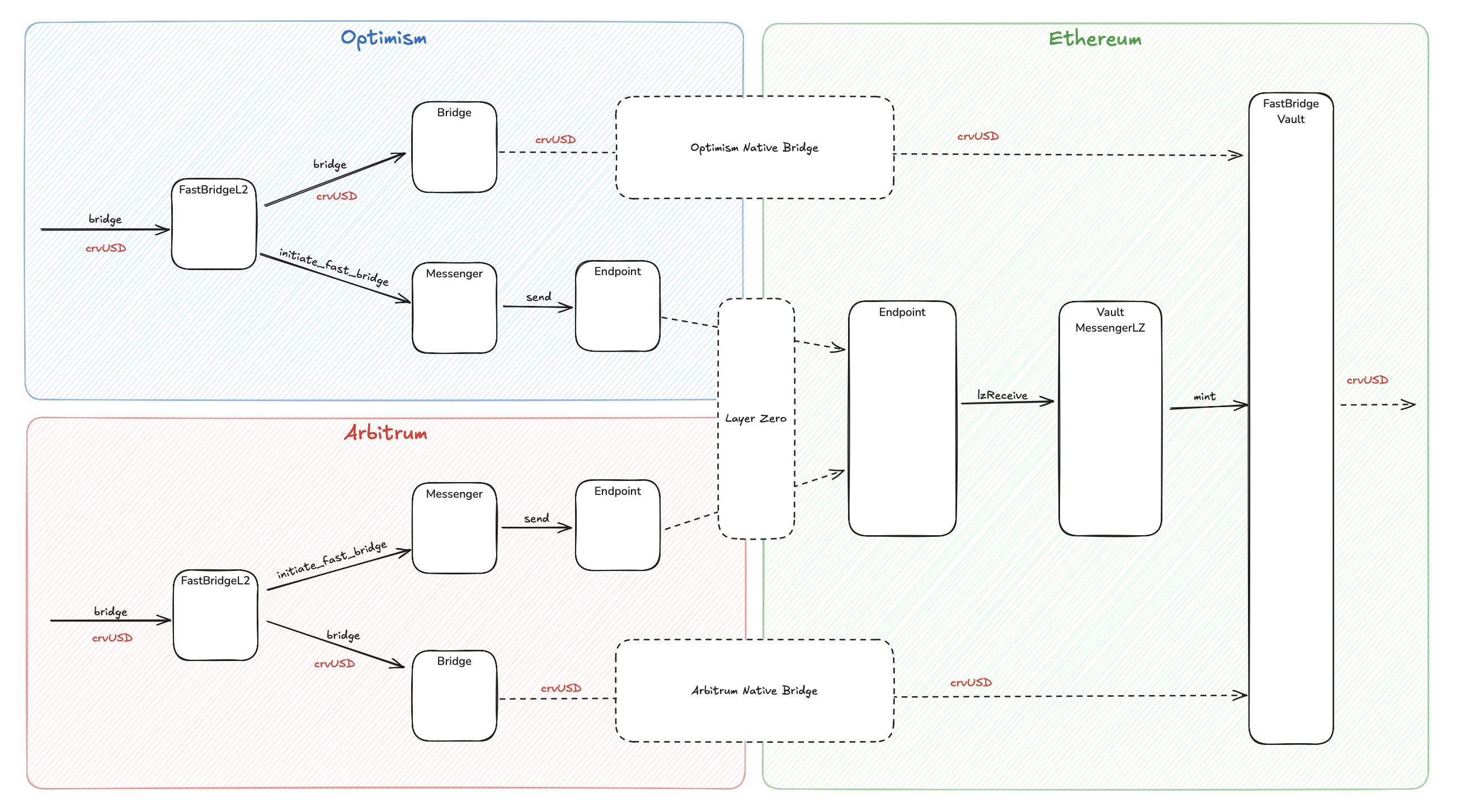
The core idea behind FastBridge is straightforward. When a user bridges crvUSD from supported L2s to Ethereum, two processes start simultaneously:
- The user's crvUSD enters the standard native L2-to-Ethereum bridge flow, which still settles through the canonical bridge after the usual withdrawal period.
- A LayerZero cross-chain message is sent to Ethereum confirming that a valid bridge transaction has been initiated.
Once that message is received, an Ethereum-side vault releases pre-minted crvUSD to the recipient before the canonical bridge withdrawal has finalized.
This advancedmint is economically backed by the pending native bridge transfer. Once the native bridge finalizes about seven days later, the bridged crvUSD arrive and replenishthe vault.
The result for users is near-instant access to crvUSD on Ethereum,while the system still relies on the secure canonical bridge infrastructure underneath.
Using FastBridge
Users can bridge crvUSD from supported L2 networks to Ethereum through the FastBridge interface.
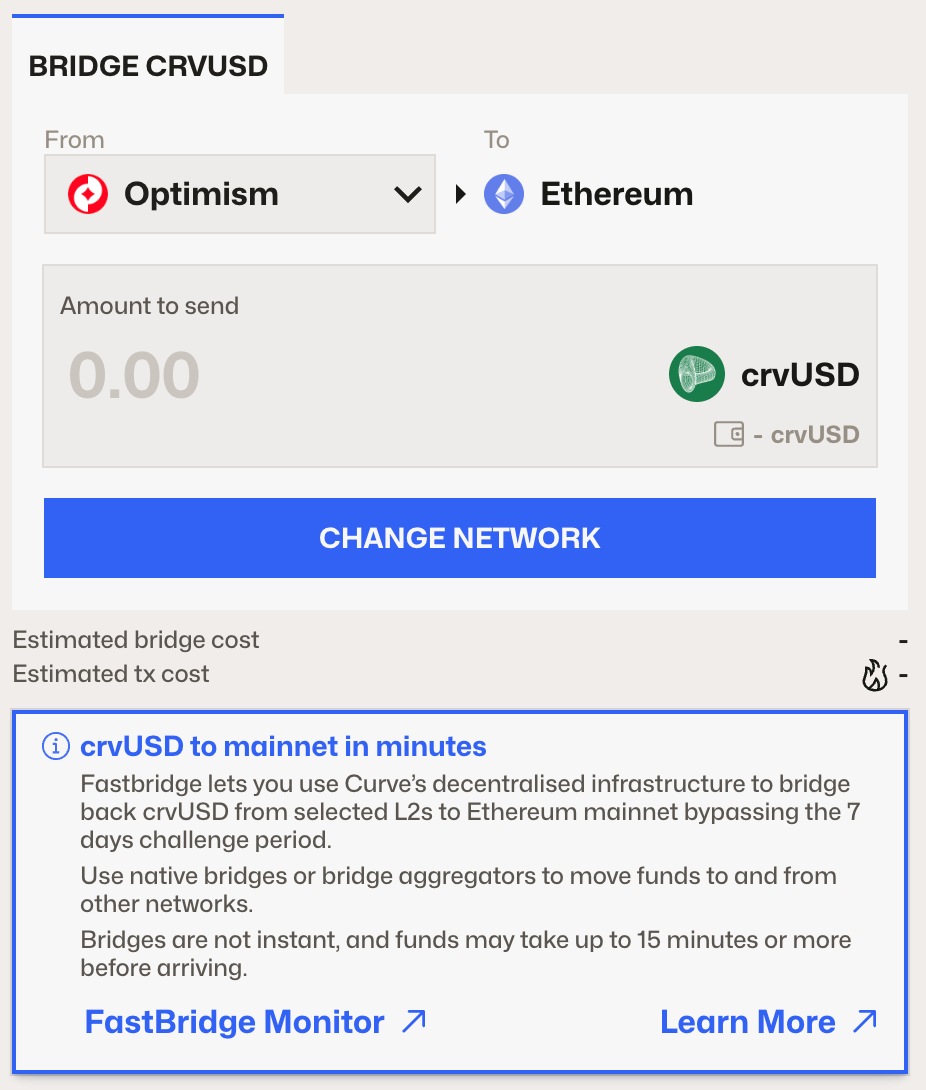
Simply connect your wallet on Arbitrum, Optimism, or Fraxtal, select the amount of crvUSD to bridge, and initiate the transfer.
Most transfers arrive on Ethereum within roughly 15 minutes, rather than waiting through the standard seven-day withdrawal period.
Access the FastBridge interface here:

Risk Management and Safety
FastBridge includes several protective mechanisms to ensure the system remains safe even under heavy usage or unexpected conditions.
- Debt Ceilings: Each vault has a maximum amount of crvUSD that can be temporarily pre-minted. This ensures total exposure remains bounded.
- Daily Bridge Limits: Each L2 network enforces a maximum amount of crvUSD that can be bridged within a 24-hour period. This prevents sudden spikes in usage from overwhelming the system. Users can check the currently available amount using the
allowed_to_bridge()function on the FastBridgeL2 contract. - Minimum Bridge Amounts: Very small transactions are blocked to prevent gas-inefficient bridge claims on Ethereum.
- Emergency Controls: Curve's Emergency DAO can instantly freeze all new mints through a kill switch if necessary. Individual minters can also be disabled independently.
- Token Recovery: In the unlikely case of malfunction, an administrative recovery function allows retrieval of stuck tokens.
Conclusion
FastBridge is more than a tool for faster withdrawals.
It is the missing infrastructure that allows crvUSD to function as a unified cross-chain stablecoin — consistent in value, easy to move, and efficient to trade.
By combining LayerZero messaging with canonical bridge settlement, FastBridge gives users fast access to their funds while enabling arbitrageurs to maintain the peg across networks. This strengthens the entire crvUSD ecosystem.
With improved peg stability, healthier lending markets, and new opportunities for cross-chain integrations, FastBridge marks an important step toward making crvUSD one of the most reliable and useful stablecoins across Ethereum and its Layer 2 networks.
For full technical details, contract addresses, and deployment information, see the FastBridge documentation: